
Progress update: Are EU Governments taking whistleblowing protection seriously?
To ensure EU governments are serious about protecting whistleblowers, the Whistleblowing International Network (WIN) joined up with Transparency International to publish a joint report and series of blogs on the progress of transposition of the EU Directive (2019/1937) on the protection of persons who report breaches of Union law - the EU Directive on Whistleblowing - which must be transposed into the national legal systems of all 27 member states before 17 December 2021.
The collaboration highlights the importance of the continued civil society coalition in campaigning across Europe for robust whistleblowing protection as an essential tool for democratic accountability, and the fight against corruption. The progress report had over forty civil society contributors, including the country editors of the EU Whistleblowing Monitor which tracks transposition progress in real time on an online platform, allowing for citizen engagement.
Read the Full Report: Are EU Governments taking Whistleblower Protection Seriously? Progress Report on the Transposition of the EU Directive.
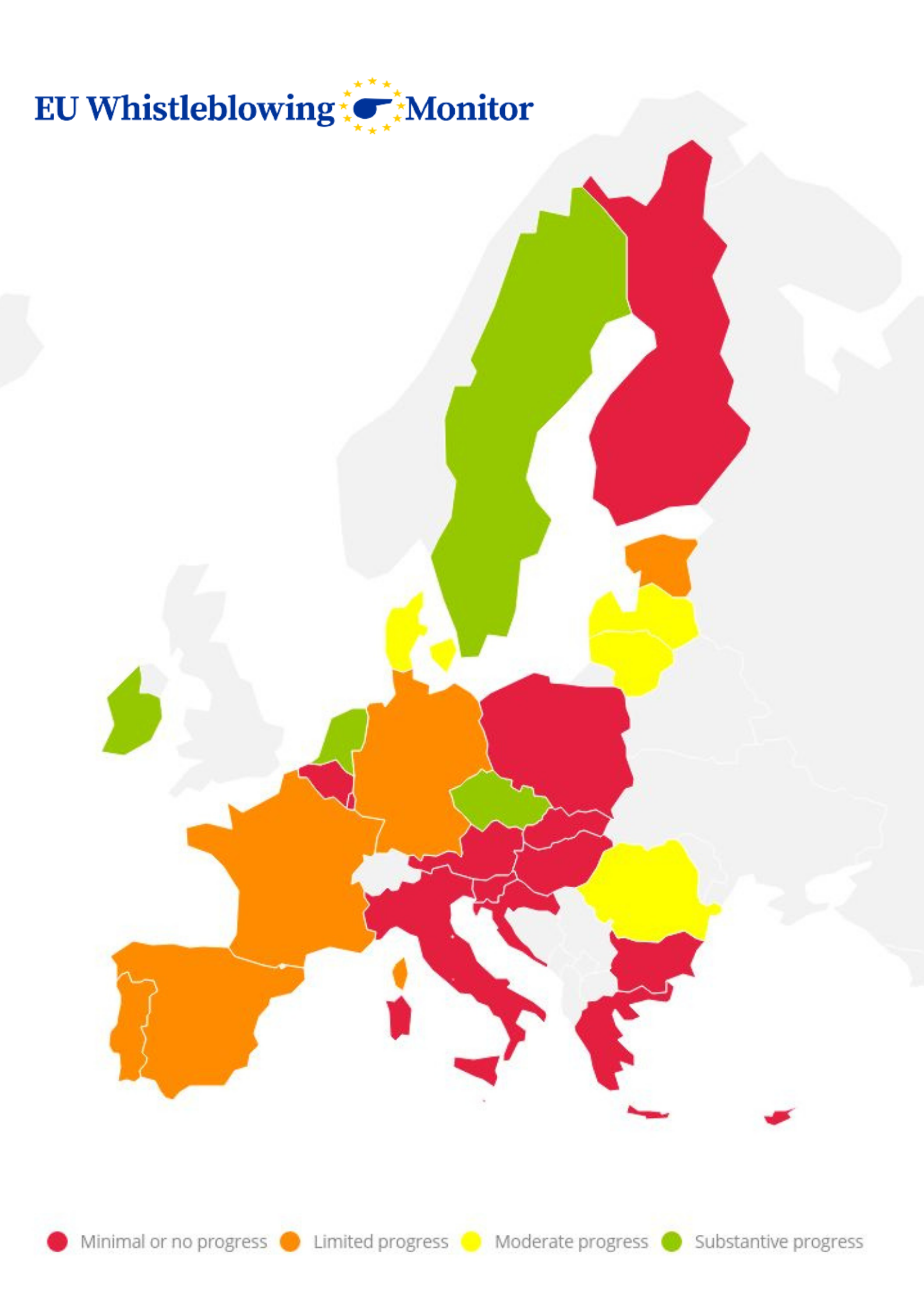
Today, on World Whistleblowing Day 2021 – less than 6 months before the deadline to transpose the Directive – we highlight key developments in EU countries since the publication of the report.
Today, on World Whistleblowing Day 2021 – less than 6 months before the deadline to transpose the Directive – we highlight key developments in EU countries since the publication of the report.
The report, published 4 months ago, found that most EU countries were seriously lagging behind in the transposition process, with two-thirds of member states not started or having made minimal progress. Only one country - the Czech Republic - was considered to have made substantive progress with the introduction of a Bill on whistleblower protection to Parliament. Whilst some governments had taken some promising initial steps, the lack of urgency was concerning.
The Directive contains many ground-breaking provisions for whistleblowing protection. It obliges public and private organisations to establish confidential reporting channels and requires a high-level of legal protection and immunity for individuals reporting a wide range of information, including directly outside of the employer organisation to the authorities, and in some circumstances directly to the media. It also foresees important support measures for whistleblowers.
Minimal, delayed or poor implementation of the Directive could further endanger and discourage people who have witnessed wrongdoing, risk or malpractice from speaking-up.
As of 18 July 2021, 14 member states appear to have still either not started or have made minimal progress towards implementing the Directive.
As of 18 July 2021, 14 member states appear to have still either not started or have made minimal progress towards implementing the Directive.
Five countries have made limited progress and four have made moderate progress towards transposition.
Four countries can now be considered to have made substantive progress:
Czech Republic
The draft law approved by government in the Czech Republic now only has only a short period to be adopted before elections in October. If the Bill does not progress in the committee stage during the week of 7 July 2021, then there is only a very small window of opportunity to timetable legislative discussions when meetings resume after summer recess in September. Information to follow on the Bill's passage through Parliament has been made available online.
Ireland
With the government approving a draft scheme of amendments Bill on the 11 May 2021 following early public onsultation on proposed reforms, Ireland is now also considered to have made substantive progress. It is not however also certain whether the proposed amendments needed to bring Ireland’s current dedicated whistleblowing law in line with the Directive can be passed before the deadline.
Sweden
Sweden, which has undertaken the most commended and comprehensive preparatory inquiry and consultation to date, has now presented an updated draft law to parliament. If passed, the law is due to come into force on the 17 December deadline, but pending final legislative steps being completed. Information on process has also been made available online.
The Netherlands
In the Netherlands, a draft bill has now been submitted to parliament as of 03 June 2021, following public consultation, the responses of which have been published online. Civil society have called for quality over speed following concerns that the complexity and inaccessibility of the proposed framework may put whistleblowers at risk.
Other key developments
- Draft Bills are now also available in Denmark, Lithuania, Portugal and Romania, and proposals are expected to be published soon in Luxembourg and Slovenia.
- Italy can now finally begin the process, having passed legislation mandating Government to start transposition.
- Much to the disappointment of civil society, a draft law failed before reaching Parliament in Germany, where there has been sustained political disagreement over whether to take a minimal or comprehensive approach.
For information on the methodology used, see page eight of the full report.
Transparency and Inclusiveness
It appears from the minutes of the EU Commission’s expert working group on transposition that the technical work of drafting provisions is well underway - but publicly available information on the formulation of proposals, and examples of inclusive and meaningful stakeholder involvement is lacking. Without proper consultation with all relevant interested parties, including those with any additional responsibilities under the new framework, as well as civil society experts, NGOs, unions and associations, laws may be rushed through which can risk doing more harm than good.
Following outcry from civil society on the lack of inclusivity, public consultations have been launched in Spain and Romania, as well as in France, but often very little time is afforded for proper engagement. In some countries only two or three weeks was allowed, well below the European Commission's own 12-week standard.
Stakeholder consultation has been launched with over 90 organisations in Denmark and an invitation to nominate civil society representatives to join a working group on transposition was recently published in Croatia in May.
Whilst we are pleased to see consultation taking place in more countries, transparency and inclusiveness of the process across the board has remained poor overall.
Member states should consider following the lead of several governments like Finland, Sweden and the Netherlands that have established dedicated online pages to make information on the process public. Early or informal consultation on draft proposals, such as on a detailed ‘intention' published in Estonia are helpful, but formal consultation with a wide range stakeholders on detailed drafts must follow.
Member states should consider following the lead of several governments like Finland, Sweden and the Netherlands that have established dedicated online pages to make information on the process public.
To read more about the importance of transparent and inclusive transposition see:
Looking forward
Whilst considered ground-breaking in providing a high-level of protection to whistleblowers, the Directive’s provisions are only minimum standards which member states must meet. It is worrying that some governments are still ignoring the repeated encouragement of the EU Commission and legal experts to adopt more comprehensive and coherent legislation and are taking a minimalist approach. This is the situation in Germany despite persuasive arguments against creating an unequal and unworkable hybrid reporting system for whistleblowers, employers and the authorities. No Directive is perfect, but the inconsistencies and loopholes we have identified will prove problematic for the protection of whistleblowers in future if they are not addressed during transposition.
Civil society experts continue to work together across Europe to monitor draft laws and benchmark against evolving norms and international best practice consensus - coalitions have formed in several countries such as in Greece, Romania and Germany. Important attention is on Article 25 of the Directive, the ‘more favourable and non-regression' clause, to ensure governments do not purposefully or inadvertently weaken pre-existing protections already available in national framework. Public education campaigns, as in the Czech Republic for example, are essential to raise awareness of whistleblowing rights, and petitions like the one run in France demonstrate the importance of pressuring government to do better.
With long summer recesses and just a few short months until the deadline, EU governments which have made minimal or limited progress towards transposing the Directive must urgently intensify their efforts.
With long summer recesses and just a few short months until the deadline, EU governments which have made minimal or limited progress towards transposing the Directive must urgently intensify their efforts. It is certainly worth remembering that Directives have “vertical direct effect” - meaning that even where a member state has not completed transposition, citizens in that county may invoke their rights against that state.
Speed must not reduce quality by rushing through flawed legislation, and careful consideration of key areas of concern must be addressed by policy makers to introduce meaningful protections which will effectively work to protect all public interest whistleblowers in practice.
For advocacy tools and guides to whistleblowing protection legislation and transposition of the Directive, see the resources page on the EU Whistleblowing Monitor. WIN is also publishing a series of policy briefings on implementing the EU Directive on whistleblowing.
Originally published by WIN.

About the author
Ida Nowers is Law and Policy Coordinator at the Whistleblowing International Network and Advocacy lead for the EU Whistleblowing Monitor.
MORE ARTICLES

The European Council must ensure EU delivers on its promise to whistleblowers
The European Council has a responsibility to protect the positive amendments made to the proposal for a whistleblower protection directive adopted by the European Parliament’s legal affairs committee last month.
Rozière positions whistleblower protection law as response to public concerns
It would be a real shame if member states’ representatives were now seen as acting against public concerns, in resisting a whistleblower protection law which encourages the reporting of crime and wrongdoing.
Danske Bank whistleblower testifies at European Parliament
The now famous Danske Bank Whistleblower, Howard Wilkinson, testified before the TAX3 European Parliament Committee last week. Wilkinson reported suspicious financial transactions at Danske Bank’s Estonia branch, where he worked until 2014.

European Parliament takes stand on stronger whistleblower directive
The WhistleblowerProtection.EU platform is celebrating a job well done, after the Legal Affairs Committee of the European Parliament passed a strengthened whistleblower protection directive, on the 20th of November.

Political battles loom in fight for robust European whistleblowers Directive
The EU’s whistleblower protection directive, is in a state of flux, key political battles are being fought right now. The whistleblower proposals as they currently stand, have several Achilles heels tucked into the directive’s fine print.

The role of media and investigative journalism
The LuxLeaks revelations were unprecedented not only in the level of corruption they uncovered, but also in the vast array of journalists from different media organisations working together to uncover corruption.
Why cross-border coherence matters
Many of the biggest whistleblower disclosures of recent years have been international in nature – LuxLeaks and the Panama Papers in particular. As pointed out by the Greens in the European Parliament, there is a general European public interest that often supersedes the national interests of a single member state.

State of play
Protection for whistleblowers in Europe is currently a patchwork affair. Some countries, such as Ireland having robust laws in place, while others, such as Cyprus, have practically none. 16 EU member states have specific laws or provisions, and 10 of those adopted their laws or in the past 5 years.
- « Previous
- 1
- 2
- 3
- 4