
Call to action: Whistleblower protection across the EU
Join us to learn about why the transposition of this EU Directive matters to you! Whistleblowing to protect journalists’ sources, workers’ rights, vulnerable communities during COVID-19 and the environment.
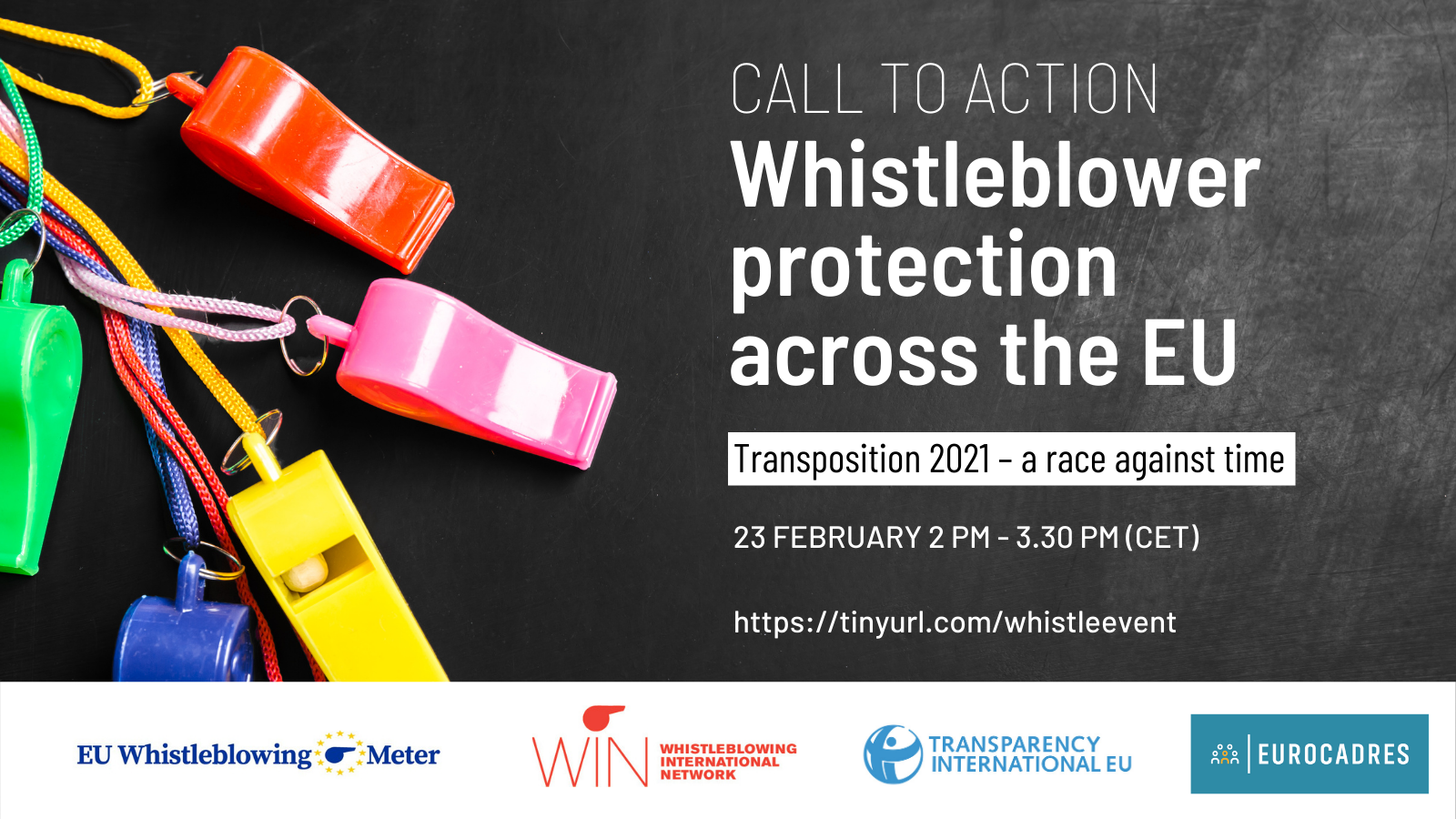
Transposition 2021, a race against time
When: 23 February, 14:00 – 15:30 (CET)
Where: Zoom, register here
In 2019 the European Union adopted a ground-breaking Directive to ensure comprehensive and coherent protection of whistleblowers across Europe. Civil society, including anti-corruption and transparency NGOs, trade unions, journalist associations, and academics were instrumental in calling for legal protections and ensuring the Directive set out a strong foundation to protect the right to speak out against wrongdoing and harm.
Whistleblowing is essential to protecting the public interest – whether it is reporting the corruption that results in sub-standard PPE equipment for front-line workers during COVID-19, or revealing systematic non-compliance with environmental or other safety standards which pollutes the air we breathe, the food we eat or the water we drink. Whistleblowers help responsible businesses learn about problems before the damage is done and help hold irresponsible organisations to account for their wrongdoing or negligence.
Twenty-seven Member States have until December 2021 to transpose the Directive into their national systems. Progress has been slow and monitoring transposition has revealed some serious problems. For example,
- Some countries are debating whether or not to protect those who report breaches of national as well as EU law despite the fact that a failure to do so would make a nonsense of any national system to protect whistleblowers
- Policy makers are still discussing a ‘good faith’ test for whistleblowers despite the EU Directive making it clear that motive is irrelevant as to whether protection is available
- Too few countries are taking the opportunity to reinforce the freedom of expression provisions to protect public disclosures and journalist sources
Join us to learn about why the transposition of this EU Directive matters to you! Whistleblowing to protect journalists’ sources, workers’ rights, vulnerable communities during COVID-19 and the environment.
Agenda
Opening remarks
Nick Aiossa, Deputy Director and Head of Policy and Advocacy, Transparency International EU
Panel discussion:
Supporting Whistleblowers Matters
- Marie Terracol, Whistleblower Protection Lead, Transparency International
- Janina Mackiewicz, Head of EU Affairs, Eurocadres
- Vigjilenca Abazi, Assistant Professor, University of Maastricht
- Camille Petit, European Federation of Journalists
Q&A
Presentation: EU Whistleblowing Meter
Ida Nowers, Law & Policy Coordinator, WIN
Q&A
Closing remarks
Anna Myers, Executive Director, WIN
Click here to register

MORE ARTICLES
Over a quarter of a million signatories support better whistleblower protection
Today trade unions and NGOs will deliver two petitions gathering over 280,000 signatures supporting the European Parliament’s demands for an improved directive.

European whistleblowers call for better directive
In an open letter to the European Council, Commission and Parliament seven well-known European whistleblowers speak out for changing the directive and removing barriers for safe reporting.
Whistleblowers could be badly served by the EU’s proposed Whistleblowing Directive
The EU Whistleblowing Directive is an idea whose time has come. New whistleblower protection laws in Ireland, France and the Netherlands showed consensus was building among EU Member States on the need to protect and enable workers to speak up about wrongdoing in the workplace.

Change the whistleblower protection directive – or it will not work
The directive must be changed to that whistleblowers can report not only a special internal whistleblowing channel, but also to managers or law enforcement.
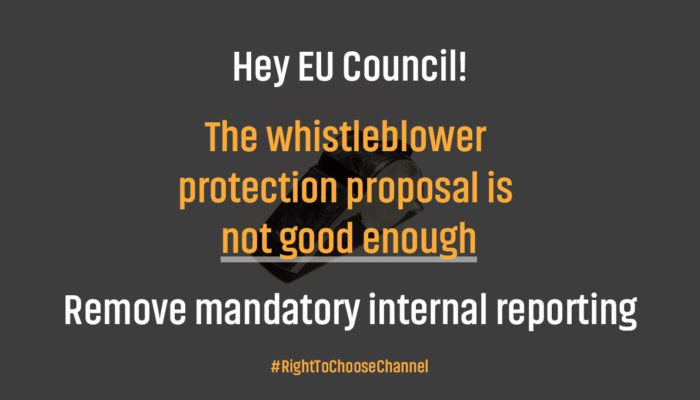
Making whistleblowing work for Europe
In an open letter 81 signing organisations urge the EU Council to adopt the Parliament’s position on reporting channels. The whistleblower protection directive is currently in trilogue. The signatories express serious concerns about the reporting channels regime in the Council and Commission positions in these negotiations.
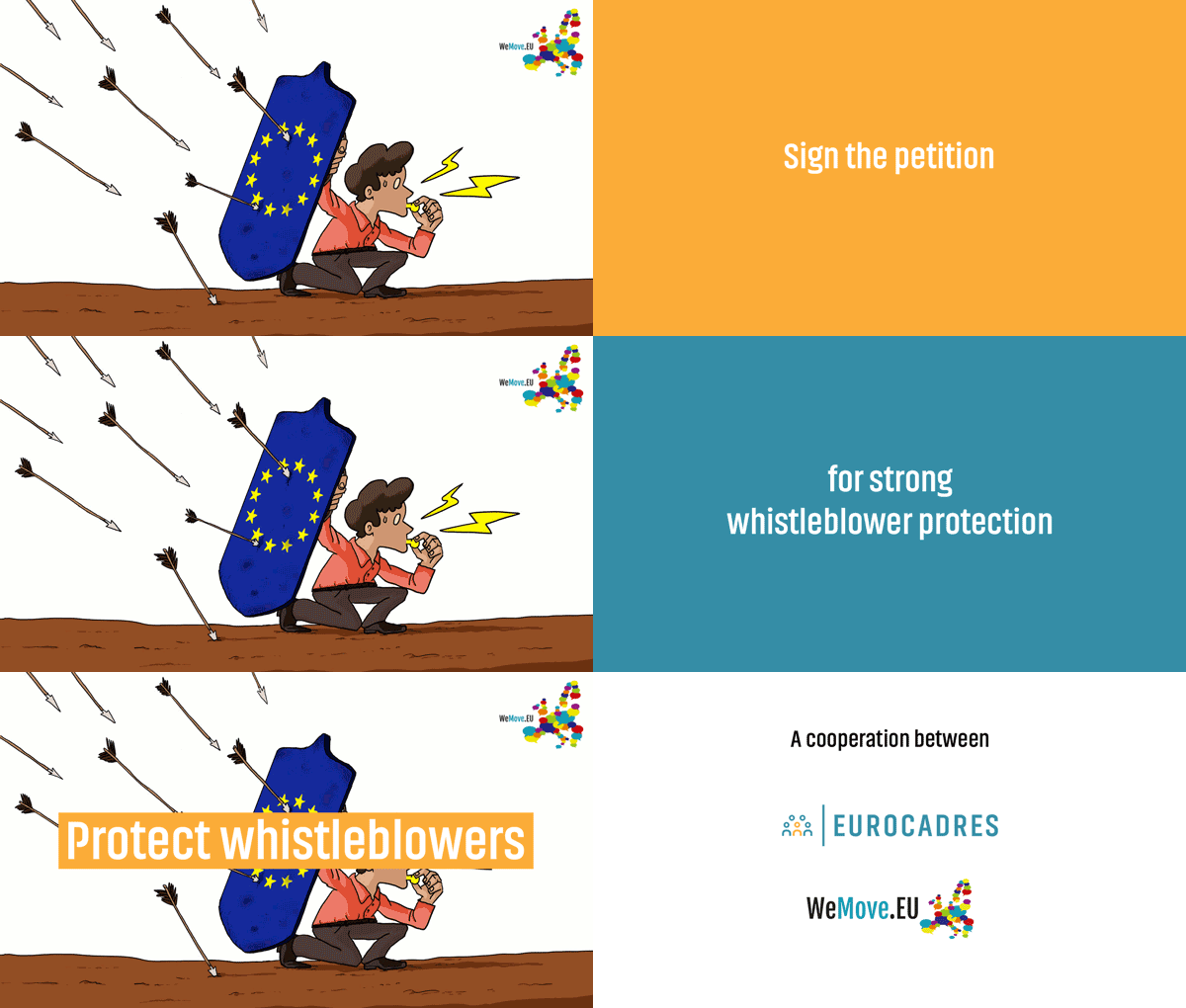
Petitioning for a better whistleblower protection directive
A few weeks left to improve the whistleblower protection directive. Make your voice heard and sign the new petition for strong whistleblower protection!
What can the EU learn from Romania’s experience implementing whistleblower legislation?
The Romanian Presidency will play a key role is securing a robust whistleblower protection Directive, argues R. Nicolae, of Syene. He believes that Romania has a number of strengths which will support it leading the negotiations, as the whistleblower protection file moves from the Council to trilogue.

Will the EU whistleblower directive prohibit the obstruction of justice?
According to the Legal Counsel of the Danske Bank Whistleblower, S. Kohn, the Howard Wilkinson case clearly demonstrates that the EU Whistleblower Directive urgently needs to be revised to protect the right to report directly to law enforcement agencies and regulatory authorities.

The Duty Speech Loophole: how the EU Whistleblower Directive could backfire against its own objectives
Tom Devine, Legal Director of GAP explains why a series of technical contradictions within the EU draft directive need to be resolved, or the legislation could backfire and actually work against whistleblowers.
Legal issues must not derail whistleblower protection law
Council legal opinion must not be used to delay completion of whistleblower protection legislation
- « Previous
- 1
- 2
- 3
- 4
- Next »