
Rozière positions whistleblower protection law as response to public concerns
European institutions have been seen as being too close to lobbyists and vested interests. It would be a real shame if member states’ representatives were now seen as acting against public concerns, in resisting a whistleblower protection law which encourages the reporting of crime and wrongdoing, said Virginie Rozière MEP.
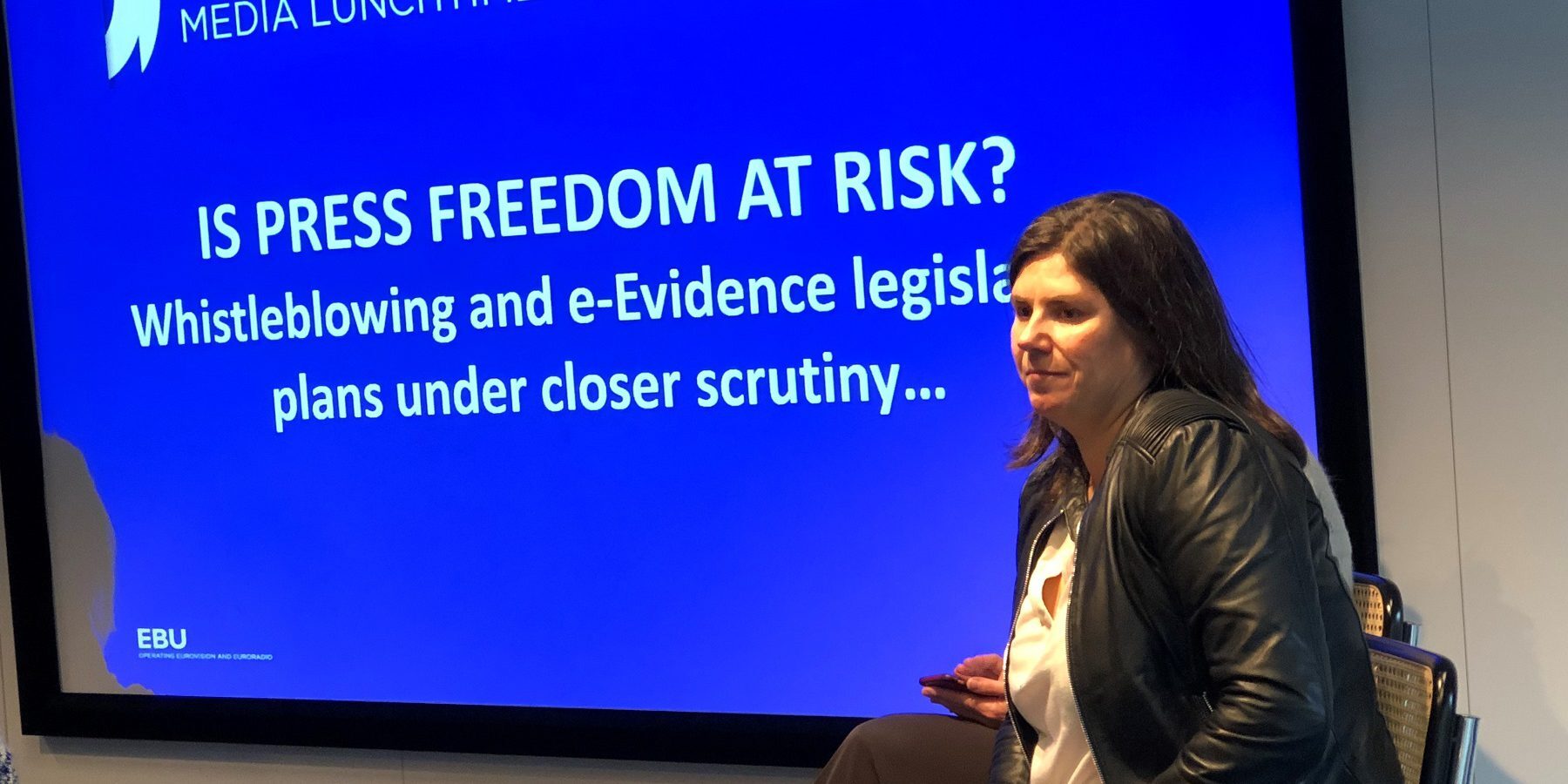
The Rapporteur for the Whistleblower Protection Directive spoke at the recent European Broadcasting Union (EBU) event. Two days after successfully steering the whistleblowers protection measures, through the EP’s Legal Affairs Committee.
‘The European Parliament and the Council have to embrace the fact that elections are close at hand. Whistleblowers have largely driven the current mandate of the European Parliament (EP)’, Rozière stated.
Whistleblowers combat money laundering & tax evasion
If you think about Lux Leaks, the Panama Papers and now the Danske Bank case, whistleblowers interventions and revelations have been essential in helping us combat tax fraud, tax evasion and money laundering, continued the MEP. So, it is important that we in the EP now give them our protection and support with an ambitious whistleblower protection law, which was only partially represented in the initial proposal developed by the European Commission.
Whistleblowers have largely driven the current mandate of the European Parliament
On the strict stepped approach to reporting, where internal reporting is mandatory as a first step, the MEP highlighted the 2014 Council of Europe Recommendation on protection of whistleblowers. It acknowledges that ‘the individual circumstances of each case will determine the most appropriate channel’ when it comes to reporting.
Challenges ahead for directive
Reflecting on the upcoming battle to get the whistleblower protection adopted, Rozière said it could be a challenge to get both the hierarchy between external and internal reporting deleted and reporting on workers’ rights added, as there seems to be reservations in both the Council and from the Commission.
Whistleblowers are best placed to determine whom to disclose the information they have uncovered to, including reporting to the media
Chairing the event, Nicola Frank, EBU’s Head of European Affairs emphasised the importance of whistleblowers as a source for investigative journalism. She also noted that whistleblowers are best placed to determine whom to disclose the information they have uncovered to, including reporting to the media, which was included in the report on the directive, recently adopted by the EP. Frank welcomed the EP committee’s decision to delete the stepped approach to reporting, despite fierce political opposition.
MORE ARTICLES

Coalition to make whistleblowing safe during COVID-19 and beyond
We call on all public authorities and institutions to protect those who report or expose harms, abuses and wrongdoings arising from the COVID-19 crisis.

New page for resources
We have added a section to the website with different reports and studies concerning whistleblowing as well as the EU directive.

Santa came early to whistleblowers. Now the work starts.
From 16 December 2019 Member States have two years to implement the Whistleblower Protection Directive into national law. Time to lobby for better laws.
Be prepared for transposition
The official adoption of the whistleblower directive is foreseen for the autumn. The directive protects persons who report in a work-related context inboth the private and public sector.

What now for the new Whistleblower Protection Directive?
On Tuesday it was all about the euphoria of the whistleblower protection Directive being adopted by the European Parliament (EP) in Strasbourg. Now the hard work begins again, as politicians, trade unions, NGOs and whistleblowers meet to discuss; “The future of the new [whistleblower protection] Directive”, at a civil society event at the European Parliament, on the 17th of April.
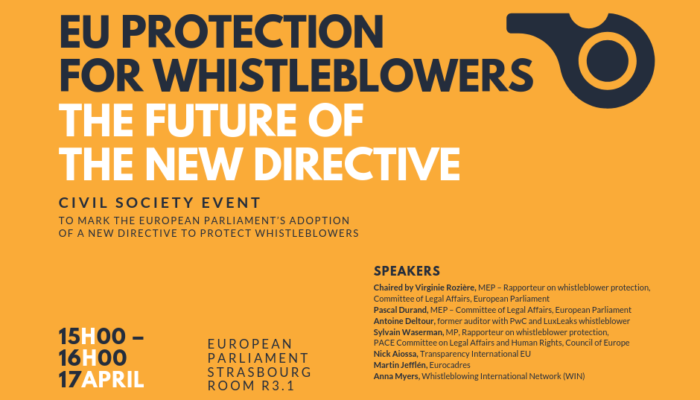
The future of the new whistleblower directive
In the final session before the EU elections, the European Parliament will vote for a new EU Directive to protect whistleblowers in Europe. Civil society played an essential role in making this happen.
JURI unanimously accepts trilogue’s whistleblower protection deal
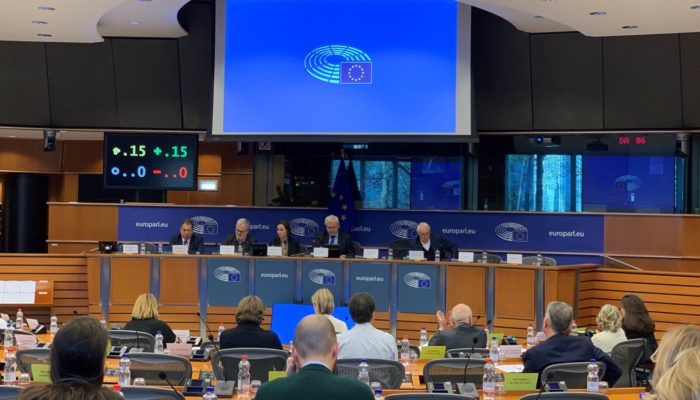
Warm applause greeted the unanimous adoption of last week’s trilogue provisional agreement on whistleblower protection, at today’s European Parliament Legal Affairs Committee.
Whistleblower Protection platform largely welcomes EU agreement
Members of the WhistleblowersProtection.EU platform mainly welcomed the provisional agreement reached by the European Parliament, the Commission and the Council, in the early hours of the 12th of March.

EU whistleblower directive must give whistleblowers all reporting options
The European Union is expected to shortly adopt the EU’s flagship whistleblower protection directive. EPSU, believes it is essential that the final legislation fully protects whistleblowers and encourages whistleblowers to report wrongdoing, through which ever route they consider most appropriate, be that the media or relevant authorities.

Handover of 280,000 petition signatures calling for a better directive
MEP Virginie Rozière, European Parliament Rapporteur for the proposed whistleblower protection directive, yesterday, received petitions with more than 280,000 signatures, gathered by coalitions of trade unions and NGOs, which she handed over to the Council of the European Union at the final scheduled trilogue in the Parliament on Monday 4 March.
- « Previous
- 1
- 2
- 3
- 4
- Next »