
Can transposing the Whistleblower Protection Directive be done on time? Maybe, but not at the cost of transparency and inclusiveness
EU governments were given two years to bring their national whistleblowing frameworks in line with the EU Directive on Whistleblower Protection, giving them ample time to involve relevant key experts and other stakeholders in the process of transposition.
As originally published on the TI / WIN website
This is the second in a series of blog posts to launch Transparency International & WIN's joint report Are EU Governments Taking Whistleblower Protection Seriously? Progress Report on Transposition of the EU Directive.

EU governments were given two years to bring their national whistleblowing frameworks in line with the EU Directive on Whistleblower Protection, giving them ample time to involve relevant key experts and other stakeholders in the process of transposition. The fact that most countries are seriously lagging in implementing the Directive half-way through the two year timeframe should spur governments into urgent action - but delays must not be used as an excuse to take shortcuts that ultimately undermine the protection of public interest whistleblowing.
Legislation developed through consultation with a wide range of stakeholders both inside and outside government, is more likely to result in effective legal reforms. Meaningful stakeholder engagement ensures that the legislation accounts for the challenges, needs and concerns of those who will be affected, builds trust and confidence in policies, and secures necessary ‘buy-in’. By allowing all groups affected to participate in debates on the nature and scope of new legislation, policy makers gain vital insights from a range of perspectives to better assess where the ‘public interest’ lies, which is particularly important for whistleblower protection legislation.
Different actors play important roles in any whistleblowing protection framework, from public institutions, national authorities, courts, journalists, trade unions, private companies, and civil society. If these voices are not adequately heard when the law is developed and stakeholders do not have confidence in how they are meant to fulfil their responsibilities, implementation of the law will be poor.
Lack of inclusiveness would also mean losing out on valuable expertise. Whistleblowing protection expertise – in developing effective law and policy as well as institutional reporting frameworks – resides largely in Civil Society Organisations (CSOs). Many Transparency International national chapters operate whistleblower reporting platforms and advice centres, as do the non-profit members of the Whistleblowing International Network. Both civil society networks also include organisations that support whistleblowers in other ways including investigations, advocacy, and research.
Wide consultation can be the first step in critically important public awareness campaigns to promote whistleblowers as acting for the common good. This is particularly important in countries where the cultural perception of whistleblowers is negative (as snitches or spies) and to explain how speaking up is an act of loyalty to one’s employer, profession or community.
Inclusiveness in the transposition process is essential, and true inclusiveness cannot be achieved without transparency.
Proactive disclosure of information on the transposition process
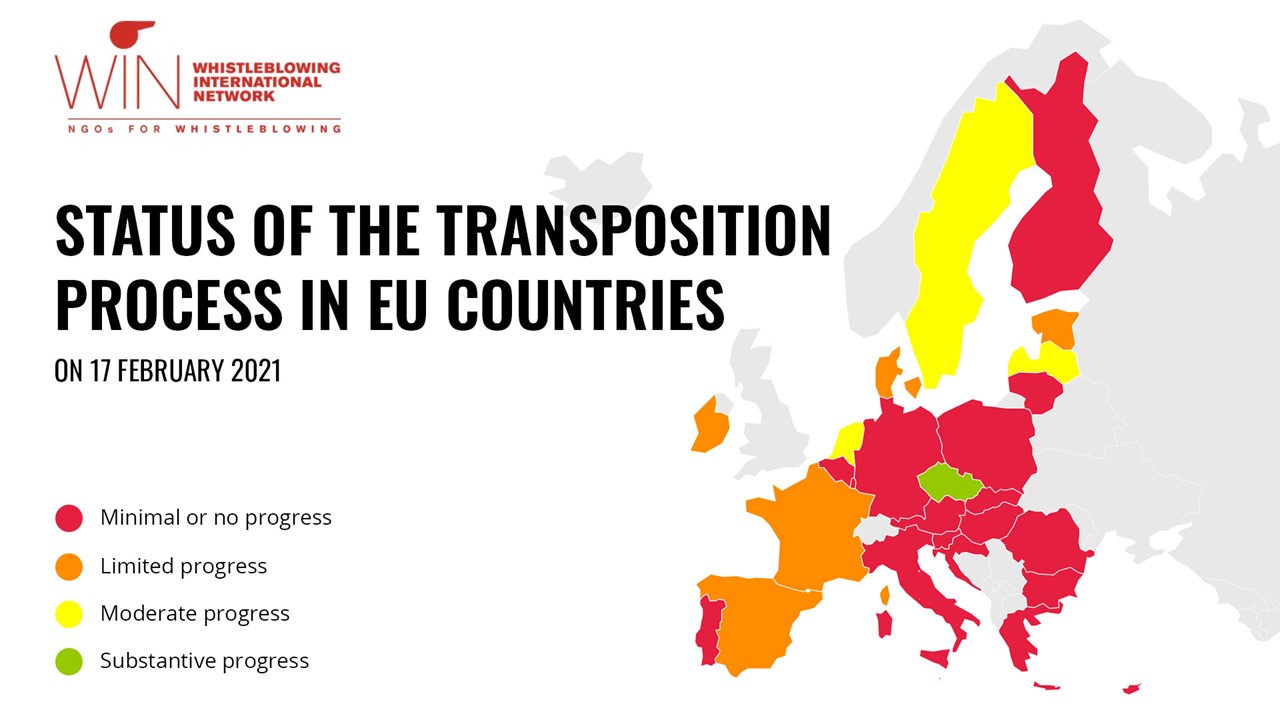
Several countries (e.g. the Czech Republic, Finland, the Netherlands and Sweden) have set up online pages dedicated to the transposition process, where key information on the process can be accessed by the public. Some countries have taken additional steps to make information accessible to a wider range of stakeholders; the Czech Republic, Estonia, Latvia, Sweden published web articles and press releases. Five countries have so far published online opinion papers from stakeholders responding to formal consultations (the Czech Republic, Estonia, Ireland, Netherlands and Sweden). These are good practices which should be adopted as a minimum standard across all EU countries.
Such openness is in stark contrast to the opacity of the process in several other countries. In Germany, where it appears the government has been working on the transposition since at least April 2020, the only official information publicly available followed an official request by a Member of Parliament. The only other available information came from leaks to the German press. In Bulgaria, no information has been public, even though the transposition process started in January 2020. In Greece, an administrative order setting up a working group on transposition dates back to May 2020, but no further information has since been forthcoming, not even to update the group’s mandate to continue work after its October 2020 deadline to complete the project was apparently not met.
Without a minimum of publicly available information on the process, it is impossible for interested parties – unless granted privileged access – to participate meaningfully in what should be a democratic process necessary to hold governments to account.
Multi-stakeholder working groups
In four countries (Bulgaria, Finland, Greece, Spain and Sweden), governments have established multi-stakeholder working groups to draft legislative proposals. Multi-stakeholder working groups are valuable as they allow hands-on stakeholder and expert involvement from an early stage. Unfortunately, none of these four working groups are known to include representatives from all key stakeholders, and it is often unclear how membership to the group is decided.
CSOs are particularly underrepresented – they do not form part of the working groups in Finland, Greece, Spain or Sweden. Other under-represented stakeholders include trade unions (missing in Bulgaria and Greece), journalists (missing in all four countries), academia (missing in Bulgaria and Sweden) and business (missing in Bulgaria). Such gaps in representation must be compensated for via other means, such as a public consultation and multilateral or bilateral meetings.
Public consultation
So far, eight EU countries have conducted public consultations (Estonia, France, Ireland, Latvia, the Netherlands, Romania, Spain and Sweden).
Public consultations are generally considered best practice, as they are by definition open to all, and provide any interested party with equal opportunity for participation (including the much-needed inclusion of whistleblowers who have experienced raising concerns or suffered retaliation, as was seen in Ireland and the Netherlands).
In the Czech Republic and Denmark, the governments have conducted formal but targeted (rather than public) consultations. Whilst the list of stakeholders consulted were relatively extensive, targeted consultations will always run the risk of “forgetting” certain parties who should be given a voice.
Timely and effective participation
Stakeholders must be given sufficient time to review documentation and formulate their comments. The European Commission has a minimum 12-week window for its public consultations. For consultations on the transposition of the Whistleblower Protection Directive, the timeframe for providing answers ranged from two short weeks in Latvia to 15 weeks in Sweden. The Czech Republic, Denmark, Estonia and Ireland provided a timeframe of one month, the Netherlands six weeks and France close to nine weeks. Romania and Spain allowed for just less than three weeks.
For any transposition process to be truly inclusive, policymakers must be ready to take stakeholders’ views into account. A prerequisite is to invite opinions at an appropriate stage, while decision-making is still open. Without this, consultations are simply box ticking exercises, and trust and confidence in the process is damaged.
In the Netherlands, in response to criticisms received during public consultation, an official from the Ministry of Internal Affairs stated that making any amendments to the draft bill to reflect recommendations received during the consultation was “unfortunately impossible”, as the Directive needed to be transposed into national legislation within a year.
If this position is confirmed when the next draft is published, it would represent a clear example of the poor practice and disappointing approach of too many governments across the EU who do not seem to be taking the implementation of such vital legal protections seriously.
Whistleblowing protection laws are fundamental to the operation of a democratic state which respects human rights and the rule of law. It is important to get them right and we hope to see more transparency and inclusiveness in the transposition process over the coming months.
Marie Terracol is the Whistleblower Protection Lead at Transparency International and Ida Nowers is the Law and Policy Coordinator at Whistleblowing International Network.
Read the report Are EU Governments Taking Whistleblower Protection Seriously? Progress Report on Transposition of the EU Directive.
The Whistleblowing International Network, Transparency International and Eurocadres run the EU Whistleblowing Meter which tracks the transposition of the EU Directive on Whistleblowing across all 27 Member States.


About the author
Marie Terracol (left) is the Whistleblower Protection Lead at Transparency International and Ida Nowers (right) is the Law and Policy Coordinator at Whistleblowing International Network.
MORE ARTICLES
Over a quarter of a million signatories support better whistleblower protection
Today trade unions and NGOs will deliver two petitions gathering over 280,000 signatures supporting the European Parliament’s demands for an improved directive.

European whistleblowers call for better directive
In an open letter to the European Council, Commission and Parliament seven well-known European whistleblowers speak out for changing the directive and removing barriers for safe reporting.
Whistleblowers could be badly served by the EU’s proposed Whistleblowing Directive
The EU Whistleblowing Directive is an idea whose time has come. New whistleblower protection laws in Ireland, France and the Netherlands showed consensus was building among EU Member States on the need to protect and enable workers to speak up about wrongdoing in the workplace.

Change the whistleblower protection directive – or it will not work
The directive must be changed to that whistleblowers can report not only a special internal whistleblowing channel, but also to managers or law enforcement.
Making whistleblowing work for Europe
In an open letter 81 signing organisations urge the EU Council to adopt the Parliament’s position on reporting channels. The whistleblower protection directive is currently in trilogue. The signatories express serious concerns about the reporting channels regime in the Council and Commission positions in these negotiations.
Petitioning for a better whistleblower protection directive
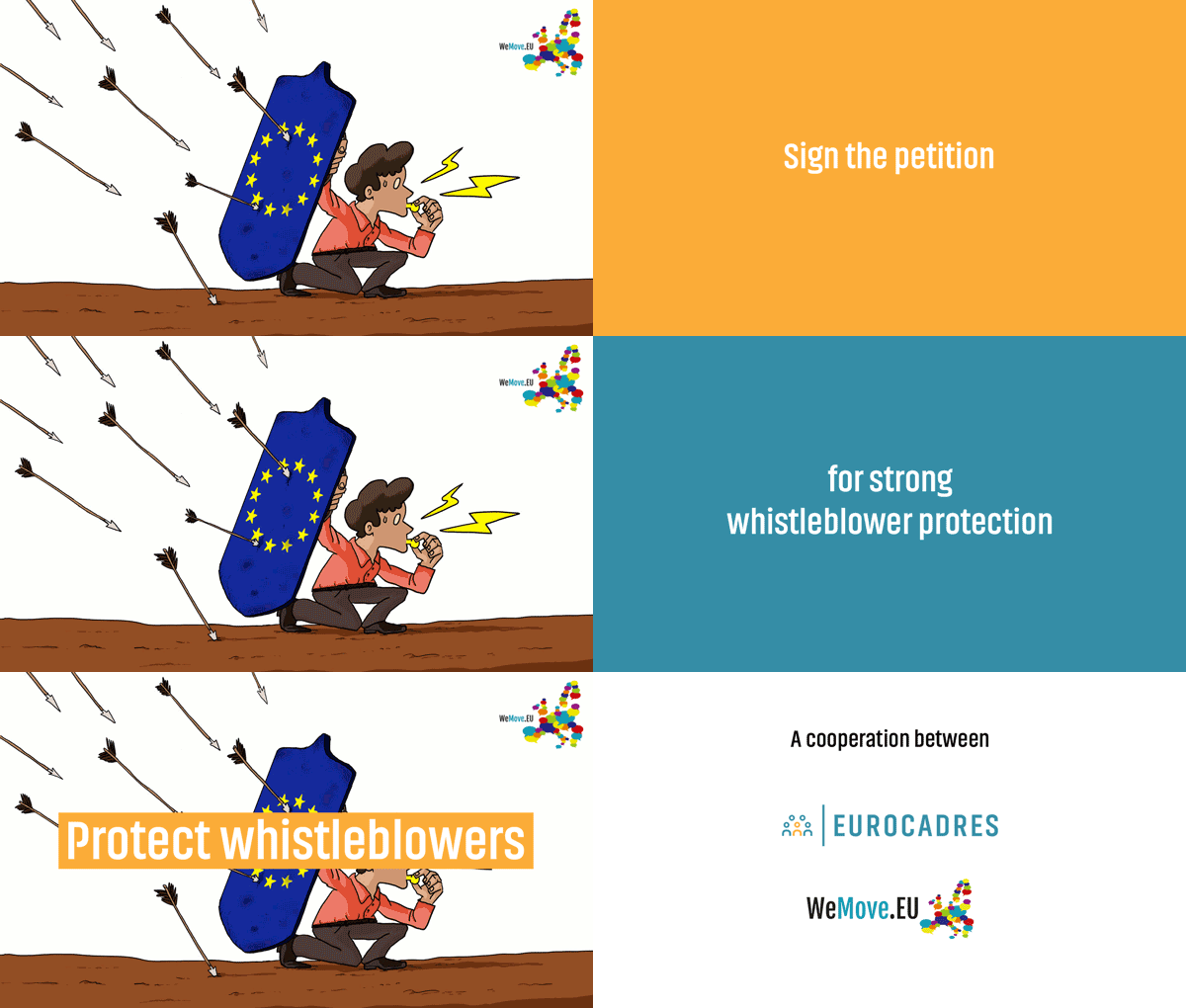
A few weeks left to improve the whistleblower protection directive. Make your voice heard and sign the new petition for strong whistleblower protection!
What can the EU learn from Romania’s experience implementing whistleblower legislation?
The Romanian Presidency will play a key role is securing a robust whistleblower protection Directive, argues R. Nicolae, of Syene. He believes that Romania has a number of strengths which will support it leading the negotiations, as the whistleblower protection file moves from the Council to trilogue.

Will the EU whistleblower directive prohibit the obstruction of justice?
According to the Legal Counsel of the Danske Bank Whistleblower, S. Kohn, the Howard Wilkinson case clearly demonstrates that the EU Whistleblower Directive urgently needs to be revised to protect the right to report directly to law enforcement agencies and regulatory authorities.

The Duty Speech Loophole: how the EU Whistleblower Directive could backfire against its own objectives
Tom Devine, Legal Director of GAP explains why a series of technical contradictions within the EU draft directive need to be resolved, or the legislation could backfire and actually work against whistleblowers.
Legal issues must not derail whistleblower protection law
Council legal opinion must not be used to delay completion of whistleblower protection legislation
- « Previous
- 1
- 2
- 3
- 4
- Next »